
I went out on the frozen front porch at sunset to admire five deer feeding in the snowy field 60 yards away. Ninja, our black spaniel mongrel, under 15 pounds, looked, growled, and shot towards them. 500 pounds of deer sprang into the woods, white tails flashing. Ninja aimed for one fawn that went by itself but they all escaped, fortunately for the dog.
Category Archives: Prose
On the Origin of Species
I finished reading Charles Darwin’s 1859 classic On the Origin of Species By Means of Natural Selection and reproduce here the final paragraph, an exquisite summation of his study of life.
***
It is interesting to contemplate an entangled bank, clothed with many plants of many kinds, with birds singing on the bushes, with various insects flitting about, and with worms crawling through the damp earth, and to reflect that these elaborately constructed forms, so constructed from each other, and dependent on each other in so complex a manner, have all been produced by laws acting around us.
These laws, taken in the largest sense, being Growth with Reproduction; Inheritance which is almost implied by reproduction; Variability from the indirect and direct action of the external conditions of life, and from use and disuse; a Ratio of Increase so high as to lead to a Struggle for Life, and as a consequence to Natural Selection, entailing Divergence of Character and the Extinction of less-improved forms.
Thus, from the war of nature, from famine and death, the most exalted object which we are capable of conceiving, namely, the production of the higher animals, directly follows.
There is grandeur in this view of life, with its several powers, having been originally breathed into a few forms or into one; and that, whilst this planet has gone cycling on according to the fixed law of gravity, from so simple a beginning endless forms most beautiful and most wonderful have been, and are being, evolved.
***
Guilt
If you don’t feel guilty about something you haven’t finished yet, maybe you are not ambitious enough. Carry your guilt proudly as a measure of what matters to you. And don’t worry, when you finish your task, you can always find something else to feel guilty about!
Every scar tells a story and gives advice
Every scar tells a story and gives advice
Michael Gollin
February 2013
***
People like to compare scars, even though that’s crude. Lyndon Johnson famously raised his shirt to show reporters the scar from his 1965 gall bladder removal. The incident is captured in a cartoon in which the scar is shaped like Vietnam.
My scars are not so dramatic, but I am attached to them. They each have a story behind them and there’s a moral to each story.
Careful about street scrapes. When I was 6, I scraped my knee while playing in Seville, Spain, where my family was visiting. Maybe it was horse manure in the street, but a few days later it was a red, pussy, swollen mess. My dad used hot compresses to soak out the strep infection, and maybe antibiotics, and lots of gauze. It was reddish for decades. It would have been better to wash it thoroughly right away.
Deal with it. I have acne scars on my cheeks, and nose, ears and shoulders. I tried to wash properly, and not to squeeze or pick, but you know how it is. Our dermatologist friend did his best, but I was a pizza face until 1984 at 27 when he referred me to a NY dermatologist who prescribed Accutane and the plague ended. I still get little whiteheads and have to use proper cleansers and occasionally the kids’ zit cream. I learned to socialize based on charm and good nature, not on a clean complexion. If I was embarrassed about the acne I never would have left my room.
Don’t overdrink. My left shin has a mystery pit scar where I must have banged into something sharp in 1977 summer at college, when a neighbor and I overindulged in gin, then made a bad decision to “borrow” bikes standing by our building, riding south and then finding the Dinky train track embankment, scrambling up, and walking the bikes along the rail ties back to our Princeton dorm rooms in New South. I awoke the next day with a headache and a huge scab on my shin and no recollection of how it got there in my anesthetized state. Stay sober enough that you know when you get injured. It’s supposed to hurt when that happens.
Beware of glass. Left middle finger, inside and above the 2d fold, there’s oa dot where a glass micropipette snapped off while I was fitting it into a rubber stop doing lab work senior year at college. I tried to fish it out with surgical tweezers but some bit remained and caused pain, gradually diminishing and disappearing over many years.
Wear gloves. At the base of my left thumb, the knuckle has a dime sized scar. In the spring of 1980, when I lived in Switzerland, I was skiing with my brother at Crans Montana and got hot, so I took off my gloves. I put my left hand down on a steep slope and skied over it with a sharp edge, sliced off a disk of skin. Hurt like crazy and bled but healed well. I bought nylon shell mittens and always cover my hands when skiing, and tried to wear work gloves whenever possible.
Careful how you cut. My left pinky tip has a scar from nail’s edge to nail’s edge. In 1982 spring one afternoon in Boston I was cutting a block of caraway Havarti freehand, sharp knife in right and cheese in left. The knife jumped and cut right through the pinky all the way to the nail. I didn’t like the look of the deep flesh as I flushed it in the kitchen sink. So I wadded a bunch of paper towels and walked over to Beth Israel ER a few blocks away on Brookline Ave. I waited a while, but figured that was OK when a screaming man was rushed in on a stretcher and rolled right to an examination room, with a sickle cell anemia attack, they said. The doctor who sewed me up said it would probably necrose – die- and fall off. But I tended it well, kept it elevated, and it healed leaving a slightly longer pinky. It has been incrementally helpful on those occasions when I played viola.
Footwear may help protect your feet, but toes get broken. Tape them together and carry on. I broke my right big toe in the Lehigh River in 1977 canoeing after a dam release when the water was so high it smashed canoes like toys. The thwarts in our canoe broke and we were rescued from the wrong side of the river by a rope brought by a kayaker. I broke a pinky toe in central Siberia in 1981, taking the Trans-Siberian Express from graduate school in Switzerland to law school in Boston, by stumbling into the person ahead of me running to reboard the train after one of its 15 minute stops along the way. I broke the other pinky in 1982 when my karate sparring partner and I both fell and I pivoted to avoid landing on her, hard. I broke my left big toe on my birthday 2012, when my right foot missed the diving board, due in hindsight to weakness as part of the onset of ALS. For a month, pain on the left concealed weakness on the right.
So take care of those wounds, make sure they heal, and learn your lessons. If you can spin the scar into a good yarn, others can learn too — without having to relive your hard experience.

***
Giving Thanks, Always, Even in Grief
Giving Thanks, Always, Even in Grief
Michael Gollin
December 2014
***
It wasn’t easy, but fourteen family members gathered at my brother’s home in Santa Fe for a joyous and spiritually meaningful Thanksgiving. After months of planning, and equipped as carefully as a Mount Everest expedition, I flew cross country with my wife, two of my children, a 250 pound power wheel chair, a bipap breathing machine, liquid food for my feeding tube, and a doctor’s note pleading for leniency from the TSA because of my disabilities caused by ALS. We had VIP treatment by the counter staff, security officers, and flight crew. Except for a delay in Washington caused by an early snow squall, the trip was fine.
My family is full of problem solvers. Brother Jim used a trailer to haul the heavy wheel chair, and made his adobe house handicap accessible using ramps and equipment generously sent, with encouragement, by Compassionate Care ALS.
Preparations for the feast were the mellowest we could recall. One reason was massage by Solar, a Brazilian shaman. When it was my turn, he didn’t work on my body, instead focusing on my spirit, which he believes surrounds our bodies and connects us to each other and everything else. It was his form of therapy and meant a lot to him. Although it was weird, it got me thinking that my body is getting weaker, but not my spirit. He was right, that I can strengthen my spirit even as my muscles atrophy.
I believe in both the physical and spiritual unity of nature. Our atoms come back as butterflies and flowers and rivers and people, and our memories and works live on. So why not our spirits, too, in an endless cycle?
Our Thanksgiving tradition is for each person to give thanks in remarks short or long. I thanked each family member for their remarkable traits, using my speaking app. I realized our Thanksgiving celebrations have become a quasi-religious ritual that we practice every year diligently to celebrate our love for each other and our good fortune, as descendants of immigrants in this great nation.
This year we were able to extend the celebration the next day with a spiritual retreat at the Upaya Center down the road. My family is not emotionally expressive. My terminal illness is the 800 pound gorilla and elephant in the room that no one really knows how to deal with. But through exercises involving meditation, writing, reading, and listening, Roshi (Zen master) Joan Halifax got us all openly sharing our experience of grief, and thereby, love.
Roshi Joan’s life work includes helping caregivers to apply Zen compassion in dealing with people who are terminally ill. She says when one family member is seriously ill, the whole family shares it. Her latest book, Being With Dying, is a gentle guide through this rough terrain. She had the 14 of us sit with her in chairs in a circle in the huge, simple sanctuary of planks and logs. We began by grounding ourselves and meditating about having strong backs and soft compassionate fronts.
Channeling my insight from the day before, I recited a prayer: Oh! Spirit that connects each of us to each other and our physical world, let us enjoy this adventure to find more meaning together.
Then out came paper and pens, and everyone was asked to write for five minutes, beginning: “What I have learned about grief is…“ We swapped and read the nano-essays, with authors unidentified. Remarkably it was almost impossible to know who wrote what. I guess we were writing about general truths.
Here is what I wrote.
What I have learned about grief is that it is a process of digesting trouble into something we can tolerate and even find strength and emotional nourishment. But it is easy to get stuck in shock denial anger or bargaining and not find our way to the peace of acceptance. It is a skill that can be mastered with help. I go through it every day at least once, sometimes more as I mourn the loss of yet another ability and contemplate mortality. And I am refreshed and relieved when I come through it again, each time.
Some other remarks were:
All of a sudden an image, a memory, a place takes you back to an event with someone now gone. … The emptiness causes your heart to shudder and your eyes to tear and your breath to catch. Then you move on, remembering only the warmth that once was there.
Each variety of grief is different.
Grief… Is ever present in all life, lurking under a rock, present in a tingling partial way, or full on, in sobs of despair… Life fully without grief is a false goal but too much grief can overcome joy, and life itself. I… rationalize:… Dying is part of life… I sob quietly. And that is OK too. The sobs stop. Life goes on.
Devotion takes as many forms as grief, its counterpart. In devotion, we find salvation from the ravages of grief.
It makes me sad to see others I care about and love feel sad. It’s good to know what others are feeling and to be open with each other.
Grief doesn’t seem like a good thing, ever, but it has the ability to teach you about yourself and those around you.
It’s so much easier to distract yourself, and it feels much better. But it’s not something you can ignore forever. Something reminds you, …and then grief reaches in, pulls for you at high tide. It’s not just one feeling, either. It’s sadness, rage, confusion, hopelessness, nostalgia, desire, guilt, betrayal, everything that comes with disaster, pain, and tragedy.
There are certain kinds of grief which I do not believe I will survive… I know – somewhere in my DNA, the code that makes me human – I have the strength to survive it. So does everyone.
When grief enters my thoughts, nothing ever seems to be as it should be.
Everyone is different. Some people can’t cry sooner, but probably everyone does later. Crying is a therapy of its own sort.
Grief cannot be eliminated, only deferred or low-keyed or overlaid with other feelings and thoughts.
Then we wrote again. “Something I didn’t say was …” I wrote:
…how glad I am to hear the many points of wisdom and deep emotional expression from my family. I feel so very fortunate.
Others wrote:
In the end it is only the love that matters, it’s the love that is the tracks we leave in the sand.
I think everyone is experiencing grief a little differently but there are also lots of similarities.
Almost everyone in the world grieves. But still, my own grief is not diminished by that awareness.
Getting one’s grief out for others to see is a liberating experience for both the grievers.
My closing prayer was: I pray for compassion, each for the other and for all of humanity and our world.
We all wrote and spoke about grief but there was lots of love in the family circle. Grief is universal and is yin to the yang of love. You don’t grieve unless you love. You can’t love without facing potential grief.
I told Roshi Joan when we planned this retreat that my family has hard shells. She told me afterwards that I was wrong. We all opened up. My mother has been suffering with tearfulness and visible grief about my illness for two years and now she feels not so alone. My father has tried to put on a happy face but now he is being more open, too. They both were able to speak about losing their parents and so many dear friends. My siblings, wife, children, and nephews and nieces all shared a fragile side. We all grew stronger, together.
On the Saturday we went to Chimayo, known for its hot peppers and the Catholic shrine. The church has a little room with a floor of dirt that is said to have miraculous healing powers. I drove my chair to the doorway and although I didn’t fit all the way in, I stood up and my brother sprinkled dirt on me.
According to that tradition, I am therefore cured. At least my spirit is.
reprinted at http://www.upaya.org/newsletter/view/2015/01/06
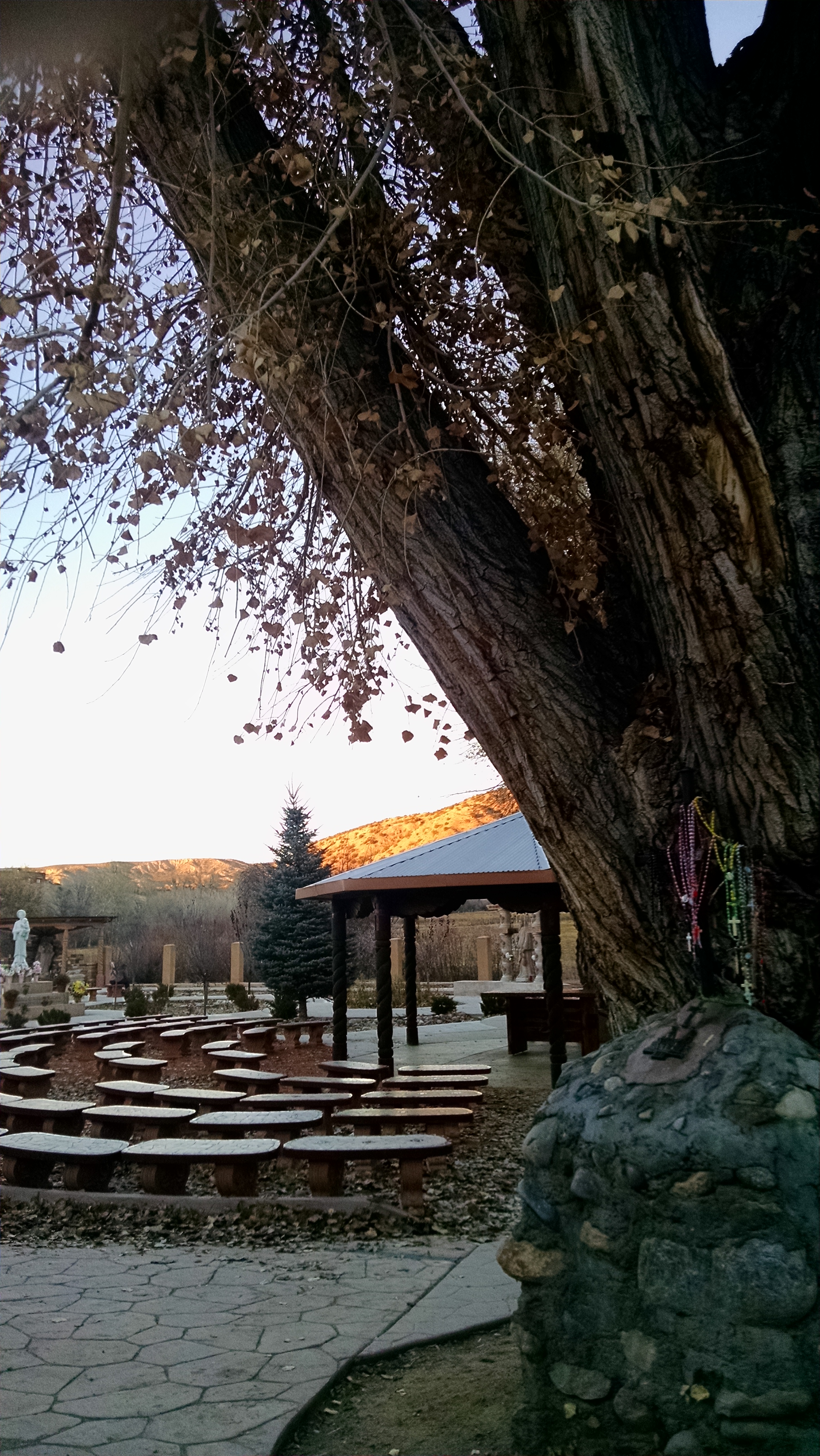
Chimayo
***
Michael Gollin video interview
April 2013
We just uploaded these videos to YouTube. It’s nice to remember being able to stand and talk back then. My current psyche was already formed. My first blog post was the same month.
The interview was recorded at MDA’s 2013 Scientific Conference, held April 21-24, 2013, in Washington, D.C. The title was Therapy Development for Neuromuscular Diseases: Translating Hope Into Promise.
List of questions and videos:
1. What is your job and background?
2. How did you learn you had ALS?
3. What ALS clinic do you attend?
4. Do you think it is ironic that you researched muscles under an MDA grant in graduate school and you are now involved with MDA again, 35 years later?
5. What led you to attend this conference?
6. What’s it like to live with ALS?
7. How has your background affected the way you have dealt with the disease?
8. What do you think about MDA’s impact?
Do you have any final comments?
Michael Gollin MDA Interview Question 1: http://youtu.be/TclHk-0mdMw
Michael Gollin MDA Interview Question 2: http://youtu.be/DQj6SIgTEcE
Michael Gollin MDA Interview Question 3: http://youtu.be/j9hZT_dD1-c
Michael Gollin MDA Interview Question 4: http://youtu.be/gZT0ikmxRdQ
Michael Gollin MDA Interview Question 5: http://youtu.be/5AQ4dCiNjMU
Michael Gollin MDA Interview Question 6: http://youtu.be/SBlQ9gjGw3M
Michael Gollin MDA Interview Question 7: http://youtu.be/m_1zVjE4pWE
Michael Gollin MDA Interview Question 8: http://youtu.be/TNWTB_N-FRk
Michael Gollin MDA Video Interview
Torture
The Senate report on Bush administration torture reminds me how awful this period was. The perpetrators’ defense of torture leads me to state my own straightforward views, based on my morality and readings.
Torture is wrong. It is evil. It makes the victims suffer abominable physical treatment and emotional and moral outrage that the physical suffering is being intentionally inflicted personally, face to face, by another human being under some form of institutional permission. The literature shows that torture inflicts permanent psychological and often physical harm. It is unconstitutional for good reason. Americans should not torture.
Likewise torture turns the perpetrators into evil doers. Studies show that those who are told to torture either resist and pay an institutional price for disloyalty or they do it and become corrupted into believing it was the right thing to do. The entire hierarchy gets caught up in defending the indefensible. The institutional integrity is damaged or destroyed. The nation that harbors torturers can not take any moral high ground and is likely to lose global influence.
The rationales for torture are bogus. First is the argument that it works. There is absolutely no good evidence of that. The CIA and Cheney defenses cite no examples, only self serving and unprovable conclusions that torture of one or two of the over 100 people we tortured provided useful information. To the contrary every study shows that the words of someone being tortured are unreliable. Did they really believe after 182 water boarding episodes with Khalid Sheikh Mohammed that the 183rd would be useful? Other methods of interrogation work much better. Ask any expert.
Even if torture worked it would still be wrong. Expediency does not justify heinous acts. We wouldn’t torture US citizens even if it worked.
Second, some people argue that terrorists deserve to be tortured because, well, they are terrorists. They attacked us, the argument goes, and they deserve what they get. Revenge may inspire reprisals around the world and some of our fellow citizens follow that primitive impulse but that is no basis for our national policy.
Moreover that argument consumes itself in hysterical illogic. Who exactly determines who is a terrorist who thus deserves to be tortured? Justice and interrogation are messy. Just because someone is apprehended on suspicion of terrorism does not mean that person is guilty or has useful information. Indeed about a quarter of the victims of US “enhanced interrogation,” aka torture, were subsequently released as mistakenly apprehended. How satisfying can revenge be when taken against innocents?
If you still want to accept torture as an American practice, try imagining this. What if you or a loved one were held wrongly as a suspect? What if you were nearly drowned and subjected to other brutal acts of torture? Would you still find it be acceptable?
Let’s be clear. Torture is an abomination. Anyone who supports it is a facilitator. This goes certainly for our former vice president Cheney and various CIA officials. We might be able to pardon or forgive the perpetrators. But we should never condone torture.
Richard Glatzer and Wash Westmoreland
Here’s an article about writer director team Richard Glatzer and Wash Westmoreland who filmed Still Alice, about Alzheimer’s, after Glatzer’s diagnosis with ALS. He types on an iPad with his foot and uses synthetic voices to communicate.
UPDATE. Glatzer watched their Oscar win from a hospital, with respiratory complications.
After 50
After 50 nothing comes for free. You have to earn everything, and pay rising interest just to stay even.
What Congress should do about ALS research
Testimony of Michael Gollin
MODDERN Cures Act Briefing
November 18, 2014
10:00 – 11:00 a.m.
2322 Rayburn House Office Building
Washington, DC 20515
Representative Leonard Lance (NJ-07)

Ready to Testify
Mr. Chairman and Guests:
My name is Michael Gollin. Thank you for the opportunity to speak about medical innovation, using my machine voice. Professionally, I am a patent attorney at the Venable law firm here in Washington, focusing on life sciences innovation, and I have taught business and law school classes on intellectual property strategy, and authored a book on the subject. Personally, I am a husband, a father, and yes, a person with ALS, the lethal motor neuron disease named after Lou Gehrig.
ALS has taken my ability to walk and talk, but not my will to advocate or my hope for a cure. I am here today to seek broad and active support in the battle against ALS. Sympathy and buckets of ice are nice, but not enough. Here are three ways Congress can help change the balance of risks to favor successful innovation.
First, Congress should provide sustained substantial federal funding for ALS research, to avoid the risk that promising basic research will be dropped or postponed, and so young scientists will enter this field.
Second, Congress should exercise oversight over the FDA and other federal agencies, to reduce the risk of delayed review and approval. There are promising initiatives to expedite drug approval for incurable terminal progressive diseases. Anyone with ALS will tell you we will tolerate much higher risk from therapy than the agencies, because the risk of inaction is a 100% certain decline into paralysis and eventual death. So, for example, after completing two clinical trials, I volunteered for a third trial involving removing parts of my vertebrae and injecting stem cells into my spinal cord. Ultimately I was rejected but dozens of other brave patients have gone ahead with that promising trial. The FDA has moved too slowly on this and other trials. Congress should encourage the FDA to apply different risk standards where there is such a catastrophic unmet medical need. By moving more quickly and creatively, FDA can encourage more private companies to invest
Third, and the main topic today, Congress should support the MODDERN Cures Act as a legislative framework to provide incentives to companies seeking new therapies for unmet needs. In my experience obtaining patents for pharmaceutical companies, I have repeatedly observed that if strong patent protection is unavailable, management will remove funding from a promising drug candidate or diagnostic. I’ve seen this happen both with neurology and cancer drugs.
Moreover, recent court decisions have gravely weakened patents for diagnostics and cutting edge genetic inventions, and I have seen clients defund research in those areas.
The Act would combat the risk of therapies lost because of weak patents. It would create incentives for companies to invest in developing new drugs despite weak patent protection. It would provide a new regulatory pathway with regulatory exclusivity for treatments and diagnostics to address unmet medical needs, like ALS. The Act would build on the great promise of personalized medicine to allow earlier diagnosis and safer, more effective, treatments.
The innovative genius of our economy is best realized when public initiatives stimulate privately funded research to solve unmet needs. The MODDERN Cures Act would harness this vital force to give pharmaceutical companies strong reasons to invest in promising therapies that would otherwise languish.
I ask you to use the enormous influence you have over appropriations, policy, and agency oversight and to adopt the MODERN Cures Act so that ALS and other incurable diseases are not forgotten. I ask you to elevate the treatment of ALS on the list of our nation’s priorities as long as necessary to find a cure.
One day we will win the battle with ALS. One day a person with ALS will quote Lou Gehrig, saying “I’m the luckiest person on the face of the earth, because I have been cured of this terrible disease.” Please join me and 30,000 other Americans with ALS, and a half million worldwide, and our families, in the fight to make that day come as soon as possible.
Thank you.
 innovationlifelove