ALS at the Oscars

Best actor was Eddie Redmayne for his portrayal of physicist and person with ALS Stephen Hawking in The Theory of Everything. I saw the movie twice and cried a river both times. First was at an ALSA screening in DC. Second was with family in Santa Fe. The movie focused on how life and love relationships and work go on despite this crushing disease.

Julianne Moore won Best actress for Still Alice. The character suffers from Alzheimer’s. Co-director Richard Glatzer has ALS and watched the ceremony from a hospital room, with respiratory complications. http://wp.me/p3lGN4-7v

Galapagos Heptagram

Galapagos Heptagram
July 2013
Michael Gollin

***
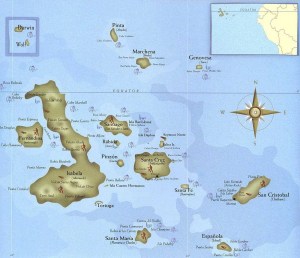
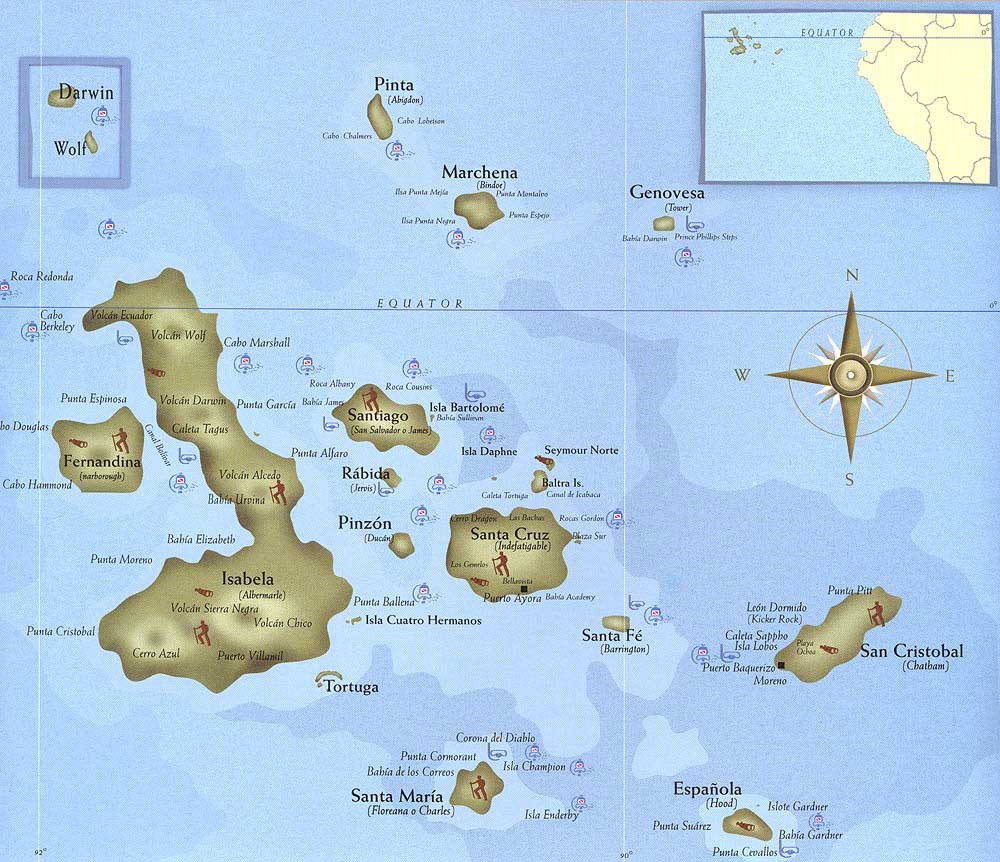
map


Ruin and death rule the Galapagos.
Animal vegetable land surf and sky.
Life begets life as everything flows.
More will come, and all will die.


1.

The Bishop’s ship drifted here
bound for Peru half a millennium ago.
Becalmed, dying of thirst, rowing away,
he reported to the Spanish King:
Abrupt, desolate, mysterious rocks
“as if God had rained stones.”
Raining stones is poetry.

At the beginning of time,
from void, star dust formed.
A molten ball then cooled and crusted.
Turbulent magma punched —
Punches —
holes to reach the sky,
volcanoes blast the earth’s inside out
hurling ash and lava,
gas and scoria, gargantuan amounts,
forming craggy masses above the sea,
not born, they explode,
cosmic stuff,
free of life and death.

But only for a moment.
Washed in restless currents of sea and wind,
the isles are immediately assaulted
in a slow concerted biological invasion,
begun a short five thousand millennia ago,
continuing today and on,
forever?


2.

500 miles away, the continent swarms
with every phylum and order of life, survivors.
Reefs of fish swim here to feed and shelter
among the tumbled rocks,
Sea lions climb out to rest and mate.
Sea birds fly and find the fish,
with stowaway seeds concealed in their feathers.

In the sky, a solid mist of aerodynamic seeds
wafts for days above the humid ocean,
then, wet with Garuá mist, rains on cool volcanic rock.

Most cannot grow. But one succeeds,
in moistened ash.
A plant appears, then more.
Moss, lichen, cactus, and shrub,
vegetable colonists.

2013-07-20 077

Insects, too, hitch rides and die,
but one and more find how to live in the new land.

Andes snow melts and runs down to the coast as rivers,
with logs and rafts of twigs stuck together,
floating out to sea.
The current, slow and steady,
delivers the load to Galapagos in weeks.
Few, but some, reptiles and insects survive
and join the colony.
An iguana here and there,
a tortoise but no hare.

What strange profusions these creatures seem.
and different on each volcanic isle.
Forced to fit this harsh mold,
by death’s inevitable
curse and blessing,
natural selection:
Those that fit breed more,
the rest breed less
and vanish from these shores.
And so pass millions of years.
Optimal not perfect.


3.

Why do they come?
Restless and alive,
living, dying or dead
or simply doing their job,
feeding the predator and scavenger.
Reaching day’s end for one,
enabling another day for the other.
It’s all about dinner.

Drifting, en route somewhere else,
carried by the currents.
Searching for a new home.
Equatorial sun and days, polar currents,
South American roots, but a South Pacific home.

Why do they come?
Chance, bad luck,
instinct, survival.

No melting pot for immigrant survivors,
this hardened lava and ash.
Species diverge and become unique
until each island flaunts
its own finch and lava lizard,
marine iguana and tortoise.

A simple basic plan –
live, adapt, survive, breed,
pass down your genes.
Incremental steps on an endless road
towards: more road,
more traveling, or more settling down.

Death and ruin in Galapagos,
for some it’s yes, for others no,
creation and rebirth,
easy come and easy go.

2013-07-16 163


4.

Floreana Island

The Baroness kept her lovers guessing,
As neighbors died in mystery, secret.
A deep lava tube dark and wet.
Above, rusty ruins of a fish canning experiment, failed
And a barrel for a post office –
put in your cards and take out those
for where you’re going.
It’s still in use.

2013-07-17 102


Espanola/Hood Island

Black marine iguanas, mottled red
in ghastly cuddle puddles
by the score, but there lies one alone,
a sort of peace, bloated,
with eyes and tongue plucked out by a hawk.
Another one lies on the rocky beach,
eviscerated by a male hawk bringing food to its babies,
mortal Prometheus,
punished for bringing this
species here.

2013-07-16 088


South Plaza

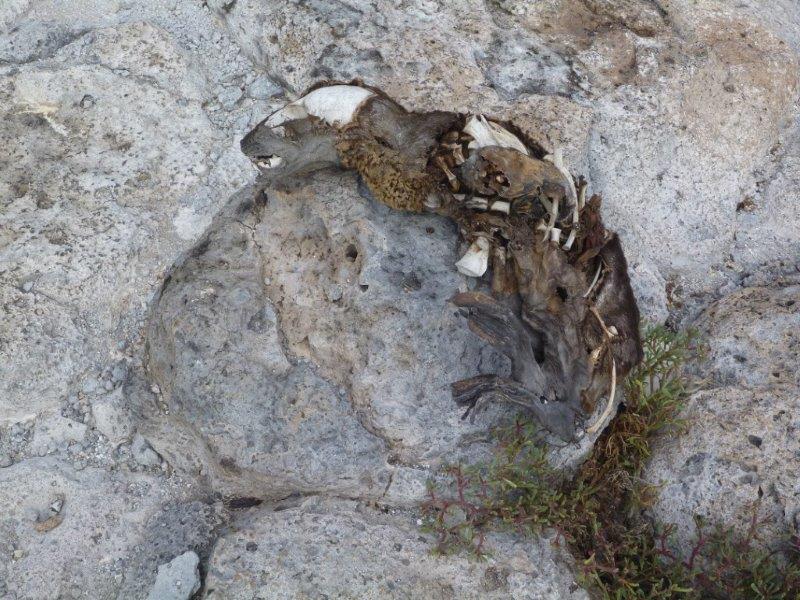
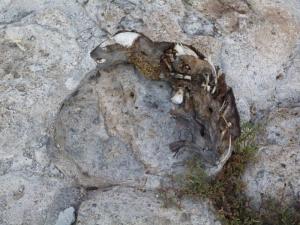
A sea lion mummy rests on the rocky shore
not forever. Something or someone will scatter the
skull and bundle of white ribs and vertebrae wrapped in sea lion leather
open on the side for a view into the private life and death of that pup.
Brown piles of lingering mothers nursing pups
and barking while males lumber over the lava rocks,
polishing them on the way to the sea.
2013-07-20 024


North Seymour

Blue-footed boobies enjoy their courtship dance,
Left, slow, right, slow,
whistle and chatter, beak clatter.
White guano ring defines the nest.
Abandoned, with pieces of broken shell.
Where’s the rest?
Hatched or eaten?

2013-07-20 044


5.

Female boobies are bigger than male boobies
but male beachmaster sea lions are bigger and tougher
than their mates, who carry a series of fertilized eggs in their wombs,
in case the males don’t find them.
The pups playing on the volcanic beach try to be like them.

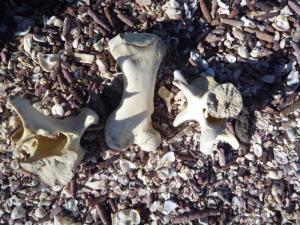
Bleached sea lion bones, ribs, fin, and tail,
every beach a graveyard and nursery,
orgy, boudoir, toilet, and living room all in one.
The tuff pups frolic in the waves,
rushing and twisting at our masks,
big brown eyes stare me down,
then woosh past, a whisker away.
Flopped on beach, or flopped on rock
10 meters down, they are at home.
Why do they not fear us?
2013-07 616 - Copy6.

Darwin came with FitzRoy’s Beagle,
In 1835.
He saw the variation and had a hunch
that natural selection could explain it all.
But he was busy chronicling barnacles and coral islands,
while Wallace wrote of evolution.
(I saw plant specimens Darwin collected.)
Then Darwin made his case
that fixed creation makes no sense.
Creation continues, today, right now.
Reproduction, variation, struggle for life,
natural selection, migration, isolation —
Life brings change,
change brings death and extinction
and new life.

Darwin expected a fight
from those who believe what they’re told,
he was right about that,
now the argument’s old.

Melville wrote of Las Encantadas in 1854,
the enchanted isles, bizarre even to him.
Sailors came from time to time,
some found water and wood.
Most exclaimed and left in disgust
at the inhospitable terrain.
They hoisted giant tortoises onto their ships,
livestock for later slaughter
200,000 over the centuries.

Settlers came again and more,
but most could not survive.
They died, or being crafty,
hitched a ride away again.

Convict, fisher, farmer, explorer —
To strangers’ eyes the sprawling land
might seem a paradise from afar.
But not when landed on the ashy shore.

The beginning of life
was in the Galapagos for many species.
Man, not so much.
Vonnegut had humans evolve into sea lions here
after the end of the world in war.
A fitting place to make a last stand.

People think it lacks creature comforts.
But there are comforts for the creatures.


7.

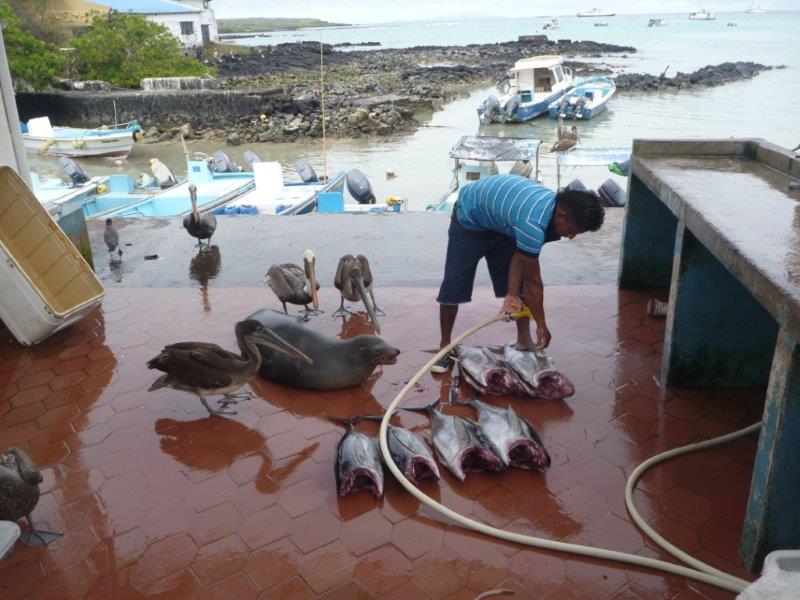
25,000 Ecuadorans live on Santa Cruz.
At the fish market the sea lions and pelicans
enjoy the guts thrown their way.
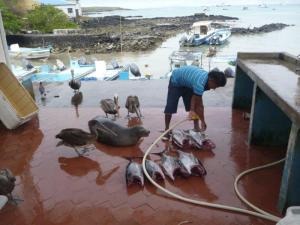
2013-07-18 111

We live for seven days on a boat
that moves from island to island,
burning 250 gallons of diesel a day.
We refuel near the US Air Force base on Baltra,
as hundreds of boobies weave their way miles
around the harbor, plunging to seize the schooling fish.

We fortunate few come to see the famous place.
we are visitors,
pilgrims,
but our captain said
“Make this boat your home this week.”
Why do we come? Curiosity, homage, adventure
by air, by sea but not by land.
I spotted over 50 species.

Why do we stay anywhere? Because we live.
We eat, play, nest, mate, rear young, explore. Survive.

Rome wasn’t built in a day
and neither was I.
The Galapagos wasn’t built in a week,
even a busy one.
But life begins anew each day
and ends again each night
until it doesn’t.
And so it goes for us all.
Rome was sacked
but took a long time to fall.
And it is still Rome,
the beautiful city of seven hills.

It’s all about dinner, said my friend,
all around the world.
Heinlein’s Stranger fed himself to his friends.
Al Capp’s Shmoos cooked themselves
to serve us a meal.
We raise animals and grains to feed ourselves.
We make the world our home.

Dillard wrote lyrically how soft life
and hard rocks shape each other in these islands.
So she understood the world:
“Everywhere freedom twines its way
around necessity.”

2013-07-20 088

Life brings change,
change brings death and new life.
We live we die
we leave our paths behind
and others walk beyond.

It all makes sense
if you dare
to go look at it all
and care.

***

Spirit

Spirit
Michael Gollin
February 2015

***

My spirit is the water within me,
a full bowl, still among
coursing currents flowing.

Vapors rise with every breath
forming air, clouds, rain, and earth.
In the wispy clouds above
I see animals and ancestors.

When the sun shines
spirit is the color I reflect
beyond eyes hair teeth and skin
like the man in the moon.

A glowing ember in my heart,
spirit slumbers,
or fanned in communion,
awakes, ignites –
spreads warmth to all around,
lights the way for ones who follow.

A flame received at birth
from forbears, a torch
to carry while running my race
until I hand it off.

Electricity crackling
through my nerves
my compass pointing north
inner peace.

My will and essence
love and compassion
good deeds done
the point of my story.

Spirit knows wrong from right
and moves at the tempo of
mountain river flower wind.
It resonates to bird song and art.

Courage and grace
a trace
a little bit
of the greater spirit.

***

Roof Rats

Roof Rats
Michael Gollin
September 2014

This is the repainted work shop roof, done by painters in September. Hopefully the power wash, rust bond coat and finish coat will stop the leaks and last at least as long as my paint job about 20 years ago.

image

That was when, as new home owners and new parents, I bought shed roof metal paint, put the ladder up and went to work. 3 year old Natasha wanted to come up so Jill hoisted her up the ladder, only about 6 feet high on the low side of the roof. We hung out for a while.

Natasha asked me if anything lived up there. Maybe we were watching squirrels. We were goofing around like we used to. I said only roof rats live on roofs. Natasha asked me what they looked like and so of course I made the hand animal with middle finger neck and the other 4 fingers as legs. She asked if they were good or bad, and I said there were good roof rats and bad roof rats. Natasha was really into conversations with fantasy critters so she wanted them to talk.

Thus began the tradition of having the right hand good roof rat tell you the good thing to do and the left hand bad roof rat tell you the bad thing to do. They would often perch on her shoulder and use funny voices to give their opposite advice.

The good roof rat says you need to brush your teeth to keep them clean and keep away germs. The bad roof rat says get them dirty and let your teeth rot, you will look more interesting with missing teeth.

The good roof rat says it’s time to go to sleep and have sweet dreams and wake up rested tomorrow. The bad roof rat says stay up late, get tired and cranky, throw a tantrum for your parents, and be ready for a grumpy day tomorrow.

It became a very fun creative and surprisingly effective way to work through many of the decisions of childhood. More imaginative than angels and devils, or “because I said so!”. And the two of them could fight. As in real life, usually the good roof rat won, but not always.

Max saw the roof rats some, and Julia too. But over time the roof rats receded to their usual lair, on roofs instead of on shoulders.

I think our kids do know good and bad, right and wrong, and how easy it is to argue about them. The roof rats served their purpose, I guess. Anyway, they are still up there on the newly repainted shed roof if any one needs to hear from them.

***

Hubris

I went out on the frozen front porch at sunset to admire five deer feeding in the snowy field 60 yards away. Ninja, our black spaniel mongrel, under 15 pounds, looked, growled, and shot towards them. 500 pounds of deer sprang into the woods, white tails flashing. Ninja aimed for one fawn that went by itself but they all escaped, fortunately for the dog.

On the Origin of Species

I finished reading Charles Darwin’s 1859 classic On the Origin of Species By Means of Natural Selection and reproduce here the final paragraph, an exquisite summation of his study of life.

***
It is interesting to contemplate an entangled bank, clothed with many plants of many kinds, with birds singing on the bushes, with various insects flitting about, and with worms crawling through the damp earth, and to reflect that these elaborately constructed forms, so constructed from each other, and dependent on each other in so complex a manner, have all been produced by laws acting around us.

These laws, taken in the largest sense, being Growth with Reproduction; Inheritance which is almost implied by reproduction; Variability from the indirect and direct action of the external conditions of life, and from use and disuse; a Ratio of Increase so high as to lead to a Struggle for Life, and as a consequence to Natural Selection, entailing Divergence of Character and the Extinction of less-improved forms.

Thus, from the war of nature, from famine and death, the most exalted object which we are capable of conceiving, namely, the production of the higher animals, directly follows.

There is grandeur in this view of life, with its several powers, having been originally breathed into a few forms or into one; and that, whilst this planet has gone cycling on according to the fixed law of gravity, from so simple a beginning endless forms most beautiful and most wonderful have been, and are being, evolved.
***

Evolving Creation

Evolving Creation
Michael Gollin
January 2015

***

Too many in my nation
choose the ancient myth
of fixed creation,
denying evolution
in their quest to get to heaven.

The blind led by the
willfully blind
lead the blind into
a fundamentally ignorant doom,
a sad and boring room,
a hell of frozen thinking
where a species never changes.

But my faith is grander.
Why deny the beauty,
the human messy majesty
the facts and arguments
of science —
biology geology
botany zoology
genetics ecology
chemistry cosmology?
The laws of nature are divine
and there before us for us to find.

Open your eyes and see!
Don’t listen just to me.
Behold creation changing
over time and every day
and shaping all of nature
as it leads us on our way.

***

Guilt

If you don’t feel guilty about something you haven’t finished yet, maybe you are not ambitious enough. Carry your guilt proudly as a measure of what matters to you. And don’t worry, when you finish your task, you can always find something else to feel guilty about!

Every scar tells a story and gives advice

Every scar tells a story and gives advice
Michael Gollin
February 2013

***

People like to compare scars, even though that’s crude. Lyndon Johnson famously raised his shirt to show reporters the scar from his 1965 gall bladder removal. The incident is captured in a cartoon in which the scar is shaped like Vietnam.

My scars are not so dramatic, but I am attached to them. They each have a story behind them and there’s a moral to each story.

Careful about street scrapes. When I was 6, I scraped my knee while playing in Seville, Spain, where my family was visiting. Maybe it was horse manure in the street, but a few days later it was a red, pussy, swollen mess. My dad used hot compresses to soak out the strep infection, and maybe antibiotics, and lots of gauze. It was reddish for decades. It would have been better to wash it thoroughly right away.

Deal with it. I have acne scars on my cheeks, and nose, ears and shoulders. I tried to wash properly, and not to squeeze or pick, but you know how it is. Our dermatologist friend did his best, but I was a pizza face until 1984 at 27 when he referred me to a NY dermatologist who prescribed Accutane and the plague ended. I still get little whiteheads and have to use proper cleansers and occasionally the kids’ zit cream. I learned to socialize based on charm and good nature, not on a clean complexion. If I was embarrassed about the acne I never would have left my room.

Don’t overdrink. My left shin has a mystery pit scar where I must have banged into something sharp in 1977 summer at college, when a neighbor and I overindulged in gin, then made a bad decision to “borrow” bikes standing by our building, riding south and then finding the Dinky train track embankment, scrambling up, and walking the bikes along the rail ties back to our Princeton dorm rooms in New South. I awoke the next day with a headache and a huge scab on my shin and no recollection of how it got there in my anesthetized state. Stay sober enough that you know when you get injured. It’s supposed to hurt when that happens.

Beware of glass. Left middle finger, inside and above the 2d fold, there’s oa dot where a glass micropipette snapped off while I was fitting it into a rubber stop doing lab work senior year at college. I tried to fish it out with surgical tweezers but some bit remained and caused pain, gradually diminishing and disappearing over many years.

Wear gloves. At the base of my left thumb, the knuckle has a dime sized scar. In the spring of 1980, when I lived in Switzerland, I was skiing with my brother at Crans Montana and got hot, so I took off my gloves. I put my left hand down on a steep slope and skied over it with a sharp edge, sliced off a disk of skin. Hurt like crazy and bled but healed well. I bought nylon shell mittens and always cover my hands when skiing, and tried to wear work gloves whenever possible.

Careful how you cut. My left pinky tip has a scar from nail’s edge to nail’s edge. In 1982 spring one afternoon in Boston I was cutting a block of caraway Havarti freehand, sharp knife in right and cheese in left. The knife jumped and cut right through the pinky all the way to the nail. I didn’t like the look of the deep flesh as I flushed it in the kitchen sink. So I wadded a bunch of paper towels and walked over to Beth Israel ER a few blocks away on Brookline Ave. I waited a while, but figured that was OK when a screaming man was rushed in on a stretcher and rolled right to an examination room, with a sickle cell anemia attack, they said. The doctor who sewed me up said it would probably necrose – die- and fall off. But I tended it well, kept it elevated, and it healed leaving a slightly longer pinky. It has been incrementally helpful on those occasions when I played viola.

Footwear may help protect your feet, but toes get broken. Tape them together and carry on. I broke my right big toe in the Lehigh River in 1977 canoeing after a dam release when the water was so high it smashed canoes like toys. The thwarts in our canoe broke and we were rescued from the wrong side of the river by a rope brought by a kayaker. I broke a pinky toe in central Siberia in 1981, taking the Trans-Siberian Express from graduate school in Switzerland to law school in Boston, by stumbling into the person ahead of me running to reboard the train after one of its 15 minute stops along the way. I broke the other pinky in 1982 when my karate sparring partner and I both fell and I pivoted to avoid landing on her, hard. I broke my left big toe on my birthday 2012, when my right foot missed the diving board, due in hindsight to weakness as part of the onset of ALS. For a month, pain on the left concealed weakness on the right.

So take care of those wounds, make sure they heal, and learn your lessons.  If you can spin the scar into a good yarn, others can learn too — without having to relive your hard experience.
image

***

Giving Thanks, Always, Even in Grief

Giving Thanks, Always, Even in Grief
Michael Gollin
December 2014


***

It wasn’t easy, but fourteen family members gathered at my brother’s home in Santa Fe for a joyous and spiritually meaningful Thanksgiving. After months of planning, and equipped as carefully as a Mount Everest expedition, I flew cross country with my wife, two of my children, a 250 pound power wheel chair, a bipap breathing machine, liquid food for my feeding tube, and a doctor’s note pleading for leniency from the TSA because of my disabilities caused by ALS. We had VIP treatment by the counter staff, security officers, and flight crew. Except for a delay in Washington caused by an early snow squall, the trip was fine.

My family is full of problem solvers. Brother Jim used a trailer to haul the heavy wheel chair, and made his adobe house handicap accessible using ramps and equipment generously sent, with encouragement, by Compassionate Care ALS.

Preparations for the feast were the mellowest we could recall. One reason was massage by Solar, a Brazilian shaman. When it was my turn, he didn’t work on my body, instead focusing on my spirit, which he believes surrounds our bodies and connects us to each other and everything else. It was his form of therapy and meant a lot to him. Although it was weird, it got me thinking that my body is getting weaker, but not my spirit. He was right, that I can strengthen my spirit even as my muscles atrophy.

I believe in both the physical and spiritual unity of nature. Our atoms come back as butterflies and flowers and rivers and people, and our memories and works live on. So why not our spirits, too, in an endless cycle?

Our Thanksgiving tradition is for each person to give thanks in remarks short or long. I thanked each family member for their remarkable traits, using my speaking app. I realized our Thanksgiving celebrations have become a quasi-religious ritual that we practice every year diligently to celebrate our love for each other and our good fortune, as descendants of immigrants in this great nation.

This year we were able to extend the celebration the next day with a spiritual retreat at the Upaya Center down the road. My family is not emotionally expressive. My terminal illness is the 800 pound gorilla and elephant in the room that no one really knows how to deal with. But through exercises involving meditation, writing, reading, and listening, Roshi (Zen master) Joan Halifax got us all openly sharing our experience of grief, and thereby, love.

Roshi Joan’s life work includes helping caregivers to apply Zen compassion in dealing with people who are terminally ill. She says when one family member is seriously ill, the whole family shares it. Her latest book, Being With Dying, is a gentle guide through this rough terrain. She had the 14 of us sit with her in chairs in a circle in the huge, simple sanctuary of planks and logs. We began by grounding ourselves and meditating about having strong backs and soft compassionate fronts.

Channeling my insight from the day before, I recited a prayer: Oh! Spirit that connects each of us to each other and our physical world, let us enjoy this adventure to find more meaning together.

Then out came paper and pens, and everyone was asked to write for five minutes, beginning: “What I have learned about grief is…“ We swapped and read the nano-essays, with authors unidentified. Remarkably it was almost impossible to know who wrote what. I guess we were writing about general truths.

Here is what I wrote.

What I have learned about grief is that it is a process of digesting trouble into something we can tolerate and even find strength and emotional nourishment. But it is easy to get stuck in shock denial anger or bargaining and not find our way to the peace of acceptance. It is a skill that can be mastered with help. I go through it every day at least once, sometimes more as I mourn the loss of yet another ability and contemplate mortality.  And I am refreshed and relieved when I come through it again, each time.

Some other remarks were:

All of a sudden an image, a memory, a place takes you back to an event with someone now gone. … The emptiness causes your heart to shudder and your eyes to tear and your breath to catch. Then you move on, remembering only the warmth that once was there.


Each variety of grief is different.


Grief… Is ever present in all life, lurking under a rock, present in a tingling partial way, or full on, in sobs of despair… Life fully without grief is a false goal but too much grief can overcome joy, and life itself. I… rationalize:… Dying is part of life… I sob quietly. And that is OK too. The sobs stop. Life goes on.


Devotion takes as many forms as grief, its counterpart. In devotion, we find salvation from the ravages of grief.


It makes me sad to see others I care about and love feel sad. It’s good to know what others are feeling and to be open with each other.


Grief doesn’t seem like a good thing, ever, but it has the ability to teach you about yourself and those around you.


It’s so much easier to distract yourself, and it feels much better. But it’s not something you can ignore forever. Something reminds you, …and then grief reaches in, pulls for you at high tide. It’s not just one feeling, either. It’s sadness, rage, confusion, hopelessness, nostalgia, desire, guilt, betrayal, everything that comes with disaster, pain, and tragedy.


There are certain kinds of grief which I do not believe I will survive… I know – somewhere in my DNA, the code that makes me human – I have the strength to survive it. So does everyone.


When grief enters my thoughts, nothing ever seems to be as it should be.


Everyone is different. Some people can’t cry sooner, but probably everyone does later. Crying is a therapy of its own sort.


Grief cannot be eliminated, only deferred or low-keyed or overlaid with other feelings and thoughts.

Then we wrote again. “Something I didn’t say was …” I wrote:

…how glad I am to hear the many points of wisdom and deep emotional expression from my family. I feel so very fortunate. 

Others wrote:

In the end it is only the love that matters, it’s the love that is the tracks we leave in the sand.

I think everyone is experiencing grief a little differently but there are also lots of similarities.

Almost everyone in the world grieves. But still, my own grief is not diminished by that awareness.

Getting one’s grief out for others to see is a liberating experience for both the grievers.


My closing prayer was: I pray for compassion, each for the other and for all of humanity and our world.

We all wrote and spoke about grief but there was lots of love in the family circle. Grief is universal and is yin to the yang of love. You don’t grieve unless you love. You can’t love without facing potential grief.

I told Roshi Joan when we planned this retreat that my family has hard shells. She told me afterwards that I was wrong. We all opened up. My mother has been suffering with tearfulness and visible grief about my illness for two years and now she feels not so alone. My father has tried to put on a happy face but now he is being more open, too. They both were able to speak about losing their parents and so many dear friends. My siblings, wife, children, and nephews and nieces all shared a fragile side. We all grew stronger, together.

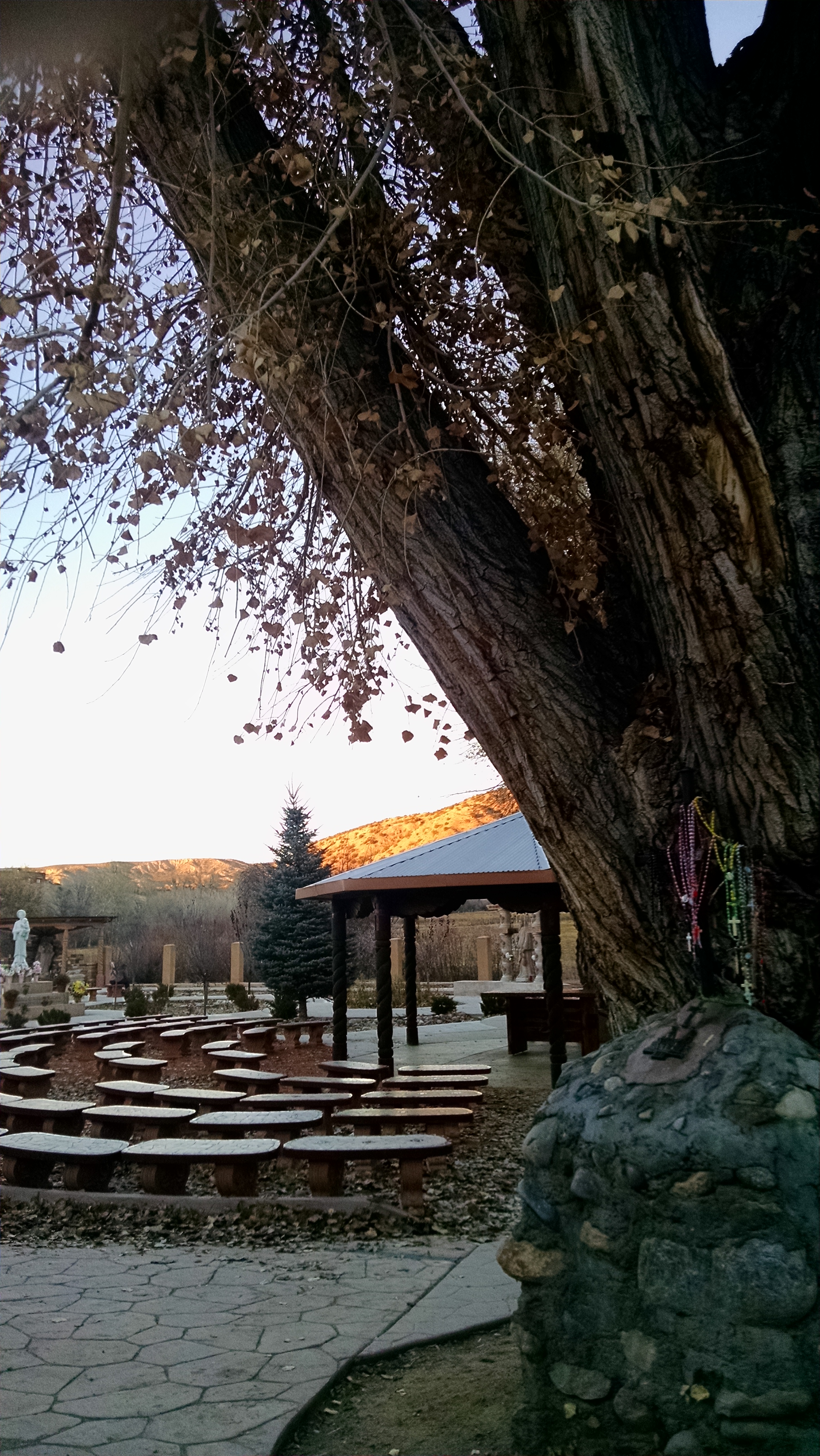
On the Saturday we went to Chimayo, known for its hot peppers and the Catholic shrine. The church has a little room with a floor of dirt that is said to have miraculous healing powers. I drove my chair to the doorway and although I didn’t fit all the way in, I stood up and my brother sprinkled dirt on me.

According to that tradition, I am therefore cured. At least my spirit is.

reprinted at http://www.upaya.org/newsletter/view/2015/01/06

image

Chimayo

***